

If you are researching solar panels for your home, factory, or a large solar project in India, you have almost certainly come across the term Mono PERC. It is the most widely installed solar panel technology in the country today — powering rooftops under PM Surya Ghar, utility-scale parks, and industrial installations from Rajasthan to Tamil Nadu.
But what exactly is Mono PERC? What are its real advantages and disadvantages compared to polycrystalline, TOPCon, or HJT panels? And in 2026, with newer technologies rapidly entering the market, does Mono PERC still make sense for your project?
This guide covers the science, the performance data, the India-specific considerations, and an honest comparison to help you make the right decision.
What Is a Mono PERC Solar Panel?
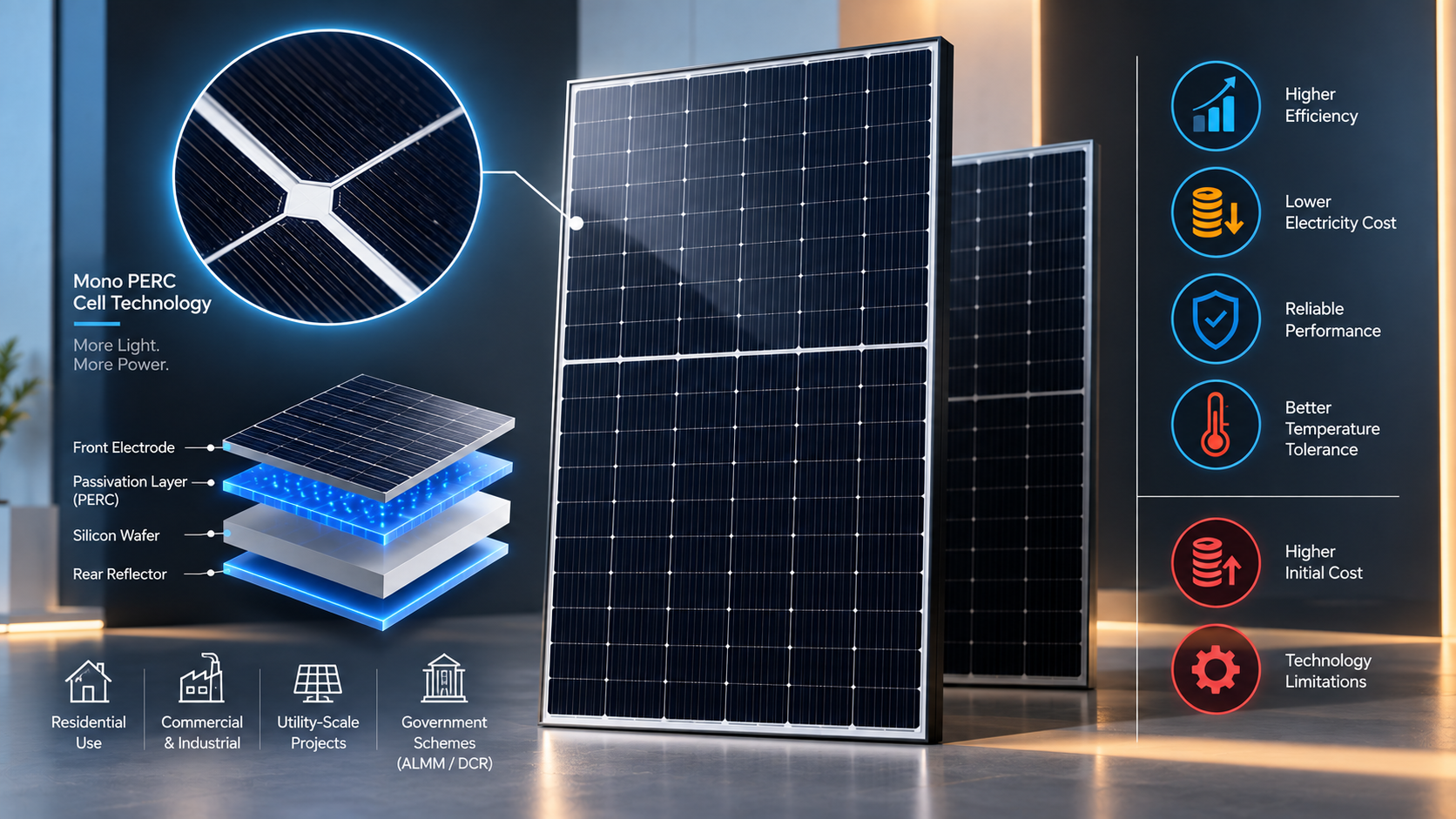
PERC stands for Passivated Emitter and Rear Cell. It is a modification of the standard monocrystalline silicon solar cell, distinguished by one key structural addition: a dielectric passivation layer on the rear surface of the cell.
In a conventional monocrystalline cell, unabsorbed light escapes from the rear as heat, and the rear surface suffers from electron recombination, where charge carriers lose energy before contributing to usable electricity. The PERC architecture solves both problems. The rear passivation layer — typically aluminium oxide (AlOx) and silicon nitride (SiNx) — reflects unabsorbed photons back into the silicon for a second pass at absorption, and chemically passivates the rear surface to reduce recombination.
This efficiency gain came with minimal changes to existing production lines, which is why Mono PERC achieved such rapid, widespread adoption from 2017 onward. The “Mono” prefix confirms the cells are cut from monocrystalline silicon — a single continuous crystal grown via the Czochralski (CZ) process — giving a more uniform, efficient structure than multicrystalline (polycrystalline) silicon, which contains grain boundaries that impede electron flow.
How Mono PERC Solar Cells Are Made
Wafer production: Monocrystalline ingots are grown via the CZ process and wire-sawn into wafers, typically 170–180 microns thick. Modern lines increasingly use M10 format wafers (182mm × 182mm) for higher power density.
Cell processing: The wafer is textured, doped to form a p-n junction, and coated with an anti-reflection layer on the front. The key PERC step is depositing the AlOx/SiNx passivation stack on the rear via PECVD (Plasma-Enhanced Chemical Vapour Deposition).
Metallisation: Metal contacts are screen-printed onto the front (silver fingers and busbars) and rear (aluminium). Multi-Busbar (MBB) designs — 9–16 thin busbars instead of the older 3–5 — reduces resistive losses and improve shade tolerance.
Half-cut processing: Most modern modules use half-cut cells, laser-cut before stringing, reducing resistive (I²R) losses by up to 75% and improving shade performance.
Module assembly: Cells are strung, encapsulated in EVA, sandwiched between tempered glass and a backsheet (monofacial) or transparent rear glass (bifacial), and framed. Modules are tested under Standard Test Conditions (STC: 1000 W/m², 25°C, AM1.5).
Key Technical Specifications of Mono PERC Solar Panels
Parameter | Typical Mono PERC (M10, Bifacial) |
Module Efficiency | 20.5% – 22% |
Cell Efficiency | 22% – 23.5% |
Power Output (per module) | 525 W – 560 W (144 half-cut cells) |
Temperature Coefficient (Pmax) | −0.34% to −0.37% /°C |
First-Year Degradation (LID) | 1% – 2% |
Annual Long-Term Degradation | 0.45% – 0.55% /year |
Power Retention at Year 25 | ≥80% of nameplate |
Bifaciality Factor | 70% – 75% |
Operating Temperature Range | −40°C to +85°C |
Standard Product Warranty | 10–12 years |
Linear Performance Warranty | 25 years |
Data based on manufacturer datasheets and industry benchmarks as of 2026.
Advantages of Mono PERC Solar Panels
- Higher Efficiency Than Standard Monocrystalline and Polycrystalline Panels
Standard monocrystalline panels achieve 17–19% module efficiency; polycrystalline delivers 15–17%. Mono PERC raises this to 20.5–22% via photon recycling and reduced recombination — meaning fewer panels is needed for a given energy target. A 5 kWp system typically needs 10–12 Mono PERC modules versus 14–16 older polycrystalline panels.
- Superior Low-Light and Diffuse Irradiance Performance
The rear passivation layer is especially effective at absorbing diffuse (scattered) radiation — the dominant light type on overcast days and at low sun angles. This matters in India, where monsoon cloud cover and haze are daily realities for much of the year. Studies show Mono PERC panels deliver roughly 5–8% more annual energy yield than standard monocrystalline panels under real-world conditions.
- Better Temperature Performance than Polycrystalline
Mono PERC’s temperature coefficient of around −0.35%/°C beats polycrystalline’s −0.40%/°C. Indian summers regularly push rooftop panel temperatures to 55–70°C; at 60°C, a Mono PERC panel loses about 12.25% of rated output versus roughly 14% for polycrystalline — a meaningful gap over thousands of operating hours.
- Bifacial Capability Unlocks Additional Energy Yield
PERC’s rear passivation naturally enables bifacial design, harvesting reflected light (albedo) from the ground. Field-tested Indian bifacial gains range from 8–23%, depending on ground albedo (white concrete/gravel outperform dark soil or grass), mounting height (0.5m+ clearance needed), and row spacing. In high-albedo, utility-scale ground-mount sites, bifacial Mono PERC can lift CUF by 10–20% over monofacial alternatives. Its bifaciality factor of 70–75% trails TOPCon (80–85%) and HJT (85–95%), but Mono PERC bifacial remains the most cost-effective bifacial option for most Indian developers.
- Widely ALMM-Listed and DCR-Compliant for Government Schemes
Under India’s Approved List of Models and Manufacturers (ALMM) framework, only List-I modules and List-II cells qualify for government-backed schemes. Mono PERC modules from major Indian manufacturers — including Websol Energy System, Waaree, Adani Solar, Tata Power Solar, Vikram Solar, and Premier Energies — are comprehensively ALMM-listed, giving full PM Surya Ghar subsidy eligibility (up to ₹78,000 residential) and DCR compliance for PM-KUSUM and CPSU Phase-II. With ALMM List-III (wafer sourcing) coming into effect by June 2028, ALMM-listed Mono PERC today sits on a fully compliant supply chain. Websol Energy System’s M10 Bifacial Mono PERC solar cells meet IEC 61215, IEC 61730, and BIS requirements.
- Proven Long-Term Reliability and 25-Year Warranty
Mono PERC entered mass production around 2015–2016 and has a decade of field data behind it. Tier-1 modules typically carry a 10–12-year product warranty and a 25-year linear performance warranty guaranteeing at least 80% of nameplate output at year 25. IEC 61215 testing (thermal cycling, humidity-freeze, damp heat, UV, mechanical load) provides third-party validation of durability.
- Cost-Efficiency Remains the Best in the Market
Mono PERC remains the most cost-efficient technology at scale in 2026: only a 3–5% price premium over polycrystalline for a 25–35% efficiency gain, and priced roughly 5–15% below TOPCon and 25–40% below HJT. This makes it the default for residential PM Surya Ghar installs, C&I rooftops with defined payback targets, and CAPEX-sensitive utility projects — typically delivering a 3.5–5-year payback for 3–10 kW residential systems.
- Compatible with Existing Inverters, Monitoring, and Balance-of-System Components
A decade of dominance means full compatibility with all major inverter brands in India (SolarEdge, SMA, Sungrow, Fimer, ABB, Growatt, Havells, Microtek). This simplifies system design and avoids the integration risks that can arise with newer technologies.
Disadvantages of Mono PERC Solar Panels
- Light-Induced Degradation (LID) — The Most Significant Technical Drawback
Standard Mono PERC cells use boron-doped P-type silicon. On first light exposure, boron reacts with trace oxygen to form boron-oxygen (B-O) defect complexes that trap electrons and reduce efficiency — causing a 1–2% output loss within the first weeks of operation, factored into year-1 warranty allowances. Gallium doping can reduce LID to below 0.5%, though it still trails N-type silicon (TOPCon, HJT). A related issue, Light and elevated Temperature Induced Degradation (LeTID), has been documented in PERC modules and can cause up to 6% additional loss under certain conditions, though it’s manageable with proper manufacturing controls. Net effect: Mono PERC retains roughly 80–83% of nameplate output at year 25, versus 87% for TOPCon — a gap increasingly pushing large developers toward TOPCon for new tenders.
- Higher Annual Degradation Rate Compared to N-Type Technologies
Mono PERC degrades at roughly 0.45–0.55%/year long-term, versus 0.35–0.40%/year for TOPCon and 0.25–0.30%/year for HJT. The compounding effect matters at scale: a 1 MW project sees tens of thousands of units of additional lifetime generation from TOPCon versus Mono PERC — a difference increasingly built into financiers’ yield models.
- Lower Temperature Performance than TOPCon and HJT
Mono PERC’s −0.35%/°C temperature coefficient trails TOPCon (−0.29%/°C) and HJT (−0.25%/°C). In extreme-heat regions (Rajasthan, Gujarat, interior Maharashtra, Telangana), where panels regularly hit 65–75°C, this gap translates to roughly 2–3% additional summer-hour output from TOPCon.
- PID Susceptibility in Humid and Coastal Environments
Potential Induced Degradation (PID) — sodium ion migration from glass into the cell — can cause sudden output drops of 10% or more. P-type Mono PERC is more susceptible, particularly along India’s humid coastline from Kerala to West Bengal. Mitigations include low-sodium glass, ion-blocking EVA, and anti-PID inverter settings, but N-type TOPCon and HJT have fundamentally lower PID susceptibility, a meaningful advantage in sustained high-humidity locations.
- Lower Bifaciality Factor Than TOPCon and HJT
Mono PERC’s 70–75% bifaciality factor trails TOPCon (80–85%) and HJT (85–95%). For ground-mount projects optimised specifically for bifacial gain, TOPCon can add another 2–5% of rear-side yield.
- Higher Silver Consumption and Input Cost Sensitivity
Mono PERC relies on silver paste for front-side metallisation, and silver prices have been volatile. While MBB designs reduce silver loading per cell, manufacturers remain under pressure to cut consumption further — Websol Energy System, for instance, reduced cell-level silver consumption by 20% in FY2025–26 and has set a further 10% reduction target. TOPCon’s N-type architecture allows partial aluminium substitution on the rear, giving it a growing cost-structure edge as silver prices rise.
- Theoretical Efficiency Ceiling
Mono PERC’s theoretical limit on P-type silicon is around 24.5%, with commercial cells topping out near 23–23.5%. TOPCon’s theoretical ceiling is ~28.7% (already exceeding 25% in production), and HJT offers a path to 26%+. Mono PERC is mature and stable, but has limited headroom left for further efficiency gains.
Mono PERC vs. Polycrystalline vs. TOPCon vs. HJT: Complete Comparison
Feature | Polycrystalline | Mono PERC | TOPCon | HJT |
Cell Type | P-type multi-Si | P-type mono-Si | N-type mono-Si | N-type hetero |
Module Efficiency | 15–17% | 20.5–22% | 22–24% | 23–24%+ |
Temperature Coeff. | −0.40%/°C | −0.35%/°C | −0.29%/°C | −0.25%/°C |
First-Year LID | 1–2% | 1–2% | <1% | <0.5% |
Annual Degradation | 0.55–0.65%/year | 0.45–0.55%/year | 0.35–0.40%/year | 0.25–0.30%/year |
Yr-25 Output Retention | ~75–78% | ~80–83% | ~86–88% | ~90–92% |
Bifaciality Factor | 60–65% | 70–75% | 80–85% | 85–95% |
PID Risk | Medium | Medium | Low | Very Low |
Relative Module Price | Lowest | Reference | +8–15% | +30–45% |
ALMM Availability (India) | Being phased out | Widest | Growing | Limited |
PM Surya Ghar Eligible | Yes (limited) | Yes (primary) | Yes (growing) | Yes (limited) |
Best For | Low-cost ground-mount | Rooftop, C&I, utility | New utility tenders | Premium/space-constrained |
Who Should Choose Mono PERC Solar Panels?
Mono PERC is the right choice for:
- Residential PM Surya Ghar buyers: For 3–10 kW rooftop systems with ample roof area, the efficiency gap versus TOPCon rarely justifies its price premium.
- C&I rooftops (100–500 kW): Where roof space is adequate, Mono PERC’s lower per-watt cost improves IRR over TOPCon.
- Budget-constrained utility projects: Fixed-tilt ground-mount projects where CAPEX per MW is the binding constraint.
- Moderate-humidity inland locations: Standard anti-PID precautions are enough, so the cost advantage isn’t offset by durability concerns.
Mono PERC is not the optimal choice for:
- Space-constrained rooftops, where TOPCon’s higher efficiency wins
- Coastal, high-humidity locations (Kerala, coastal Andhra, coastal West Bengal), where TOPCon/HJT PID resistance is preferable
- New large-scale utility tenders where 25-year yield is the primary LCOE metric
- Premium residential installs with very limited rooftop space
Mono PERC in India’s Evolving Policy Landscape
ALMM List-I and List-II: Currently in force — government-backed projects must use List-I modules and List-II cells. This makes ALMM-compliant Mono PERC the default for PM Surya Ghar, PM-KUSUM, and CPSU Phase-II installations.
ALMM List-III (Wafers): Effective June 1, 2028, a framework MNRE formally notified in March 2026. Indian manufacturers — including Websol Energy System, which has signed an MoU with Linton Crystal Technologies to evaluate domestic ingot and wafer manufacturing — are preparing for this transition. If Websol’s evaluation proceeds to a commercial facility, it would move the company toward wafer-level ALMM compliance ahead of the deadline. Buyers planning post-2028 commissioning should verify their supplier’s wafer sourcing roadmap.
PLI Scheme for Solar PV: The first Production Linked Incentive tranche focused primarily on Mono PERC; the second is bringing TOPCon capacity online, meaning domestic TOPCon availability is rising and its price premium is expected to narrow over 2026–2028.
Technology Transition: Websol Energy System is converting a 600 MW Mono PERC cell line at its West Bengal facility into a 750 MW TOPCon line, targeting completion by March 2027 at cell efficiencies around 25%. This doesn’t make existing Mono PERC panels obsolete — it simply means more TOPCon choice at lower prices over the next 2–3 years.
Conclusion: Is Mono PERC Still Worth It in 2026?
Yes — with clarity on where it fits. Mono PERC is the most mature, widely deployed, and cost-effective solar technology in India in 2026, making it the default choice for most residential and commercial installations.
It isn’t the technology of the future in the way TOPCon is — its efficiency ceiling is close, its degradation rate is higher than N-type alternatives, and it carries inherent LID and PID risks newer technologies have largely eliminated. But for PM Surya Ghar buyers, factory rooftops seeking reliable payback, and utility developers optimising CAPEX, Mono PERC delivers exactly what it promises: high efficiency, proven durability, and bankable 25-year performance at the most competitive cost.
When choosing Mono PERC modules, prioritise:
- ALMM List-I listing (mandatory for subsidy eligibility)
- IEC 61215 and IEC 61730 certification
- BIS certification (mandatory for India)
- M10 half-cut bifacial format
- Manufacturer track record and warranty credibility
Websol Energy System manufactures high-efficiency M10 Bifacial Mono PERC solar cells and modules at its Falta SEZ facility in West Bengal, with full ALMM List-I and List-II compliance, IEC 61215, IEC 61730, and BIS certifications. Established in 1994, Websol brings over three decades of manufacturing expertise to every panel it produces. Explore Websol’s solar module range to find the right solution for your project.