

India’s first large wave of grid-connected solar capacity went up between roughly 2010 and 2015. Crystalline silicon modules are typically rated for 25–30 years of service, which means the earliest installations are still years away from mass retirement. But “years away” is not “irrelevant now” — module failures, damage, repowering projects and early decommissioning already generate PV waste today, and the regulatory and industrial infrastructure to handle it at scale is being built well ahead of the larger wave still to come.
This is not a story about environmental guilt. It is a story about an emerging industrial process: what a solar module is actually made of, what of that is worth recovering, and how close India currently is to doing that recovery at scale.
What a Solar Module Is Actually Made Of
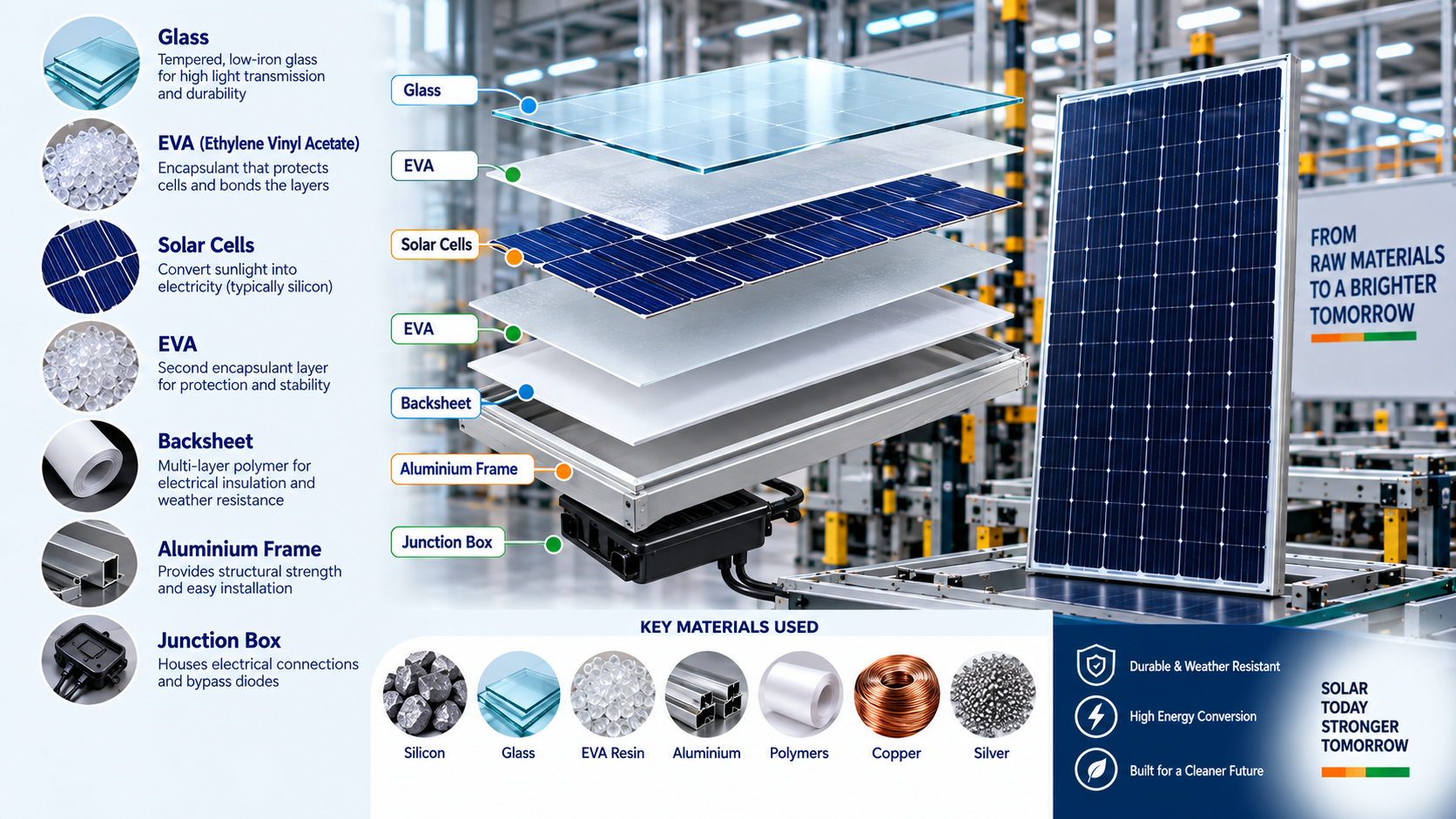
A standard crystalline silicon module is, by weight, overwhelmingly glass and aluminium — the front glass sheet typically accounts for around two-thirds of a module’s mass, and the aluminium frame for another significant share. The remainder is a mix of encapsulant (EVA or POE), backsheet polymer, copper interconnect ribbons, a junction box, and the silicon cells themselves, which contain small but valuable quantities of silver in their metallisation paste.
None of these materials are worthless once separated, but none of them are trivial to separate either. That tension — genuinely recoverable value locked inside a laminated, glued, multi-material sandwich — is the central engineering and economic problem of PV recycling.
Glass is the largest recoverable stream by weight and, in principle, the easiest to recycle — but glass bonded to EVA encapsulant and a backsheet cannot simply be crushed and sent to a standard glass furnace without delamination first, or it contaminates the recycled glass stream.
Aluminium frames are the most straightforward component to recover, since they are mechanically fastened rather than laminated, and aluminium recycling is a mature, high-value process across most industries — this is one of the more genuinely economic legs of PV recycling today.
Silicon from the cells themselves can theoretically be recovered and reprocessed, but doing so to a purity level useful for new cell production is technically demanding and not yet widely commercially deployed in India at scale; more often, recovered silicon-containing material is downgraded into lower-value applications.
Silver, present in small quantities in cell metallisation, is disproportionately valuable relative to its mass and is one of the stronger economic incentives in module recycling — the same silver-cost pressure that is pushing manufacturers to reduce silver consumption per cell during production, as covered in Websol’s article on why silver matters in solar cell manufacturing, is the same dynamic that makes silver recovery from scrap modules economically meaningful.
Copper interconnects are recoverable through standard e-waste processing routes and add modest additional value.
Repair, Reuse, or Recycle: Not Every Retired Module Needs to Be Shredded
End-of-life is not the only reason a module leaves service, and it’s worth separating the pathways clearly:
- Repair applies to modules with a fixable, localised fault — a damaged junction box or a single failed bypass diode — where the underlying cells and laminate are otherwise sound.
- Reuse (secondary market) applies to modules retired early for reasons unrelated to performance, such as a repowering project replacing older, lower-wattage panels with newer high-efficiency ones. These modules may still have significant remaining useful life for lower-stakes applications.
- Recycling is the appropriate pathway only once a module has reached genuine end of life — physically damaged beyond repair, or degraded below a usable performance threshold.
Treating recycling as the default pathway for every retired module both overstates the current waste volume and understates the value that can be recovered through simple reuse first.
Why PV Waste Is a Distinct Regulatory Category in India
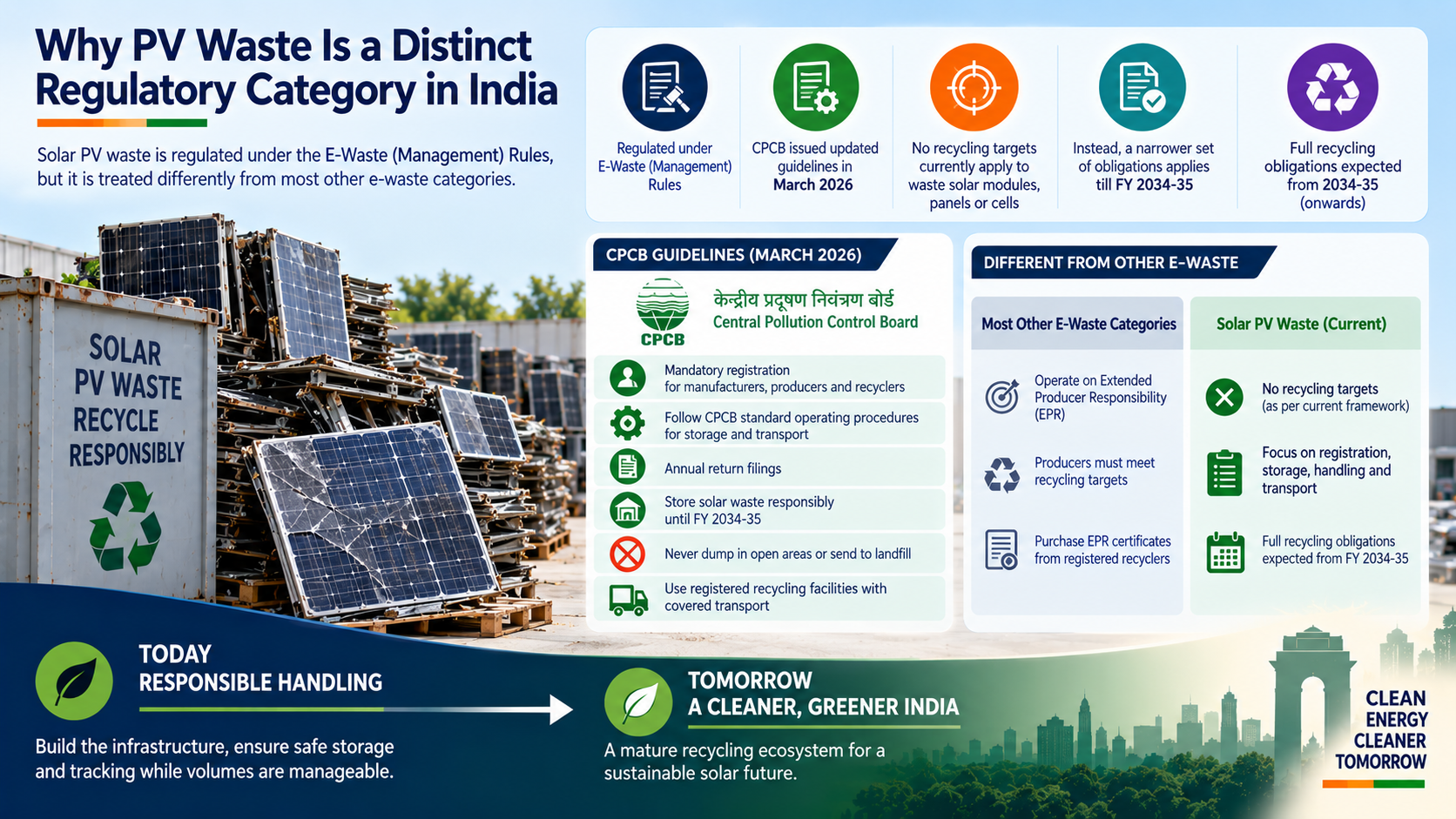
Solar PV waste in India is regulated as a category under the E-Waste (Management) Rules, but it has historically been treated differently from most other e-waste categories. In March 2026, the Central Pollution Control Board (CPCB) released updated guidelines specifically for the safe storage, handling and transportation of discarded solar PV modules, panels and cells. According to CPCB’s published guidance, the current regulatory framework does not apply recycling targets to waste solar modules, panels or cells, unlike most other e-waste categories, which operate on an Extended Producer Responsibility (EPR) basis requiring producers to meet recycling targets by purchasing EPR certificates from registered recyclers.
Instead, the March 2026 CPCB guidelines assign a narrower set of obligations to manufacturers, producers and recyclers of solar PV equipment: mandatory registration, adherence to CPCB standard operating procedures for storage and transport, annual return filings, and a requirement to store solar waste responsibly until financial year 2034-35 — the point from which full recycling obligations are expected to apply. The guidelines are explicit that solar waste must never be dumped in open areas or sent to landfill, and that recycling, when it does happen, must go only through registered recycling facilities using covered transport to prevent breakage and contamination in transit.
This is, in effect, a deliberate two-stage regulatory approach: build the storage, tracking and registration infrastructure first, while actual retirement volumes are still relatively modest, and phase in binding recycling targets later as the volume of end-of-life material grows. Industry analysts widely read the March 2026 guidelines as the precursor to a fuller solar-specific EPR framework, expected sometime around 2027-2028.
The Scale of the Problem Ahead
The reason regulators are moving now, even though the current waste volume is manageable, is the shape of the curve ahead. India’s installed solar base has grown from a low base to well over 100 GW within about a decade, and a large share of that capacity was installed in the last five years. Since panels are rated for 25-30 years, the bulk of India’s current installed base won’t reach natural end-of-life until the late 2040s and beyond — but damage, defects, repowering and early failures already generate a meaningful and growing waste stream well before then, and that stream will only accelerate as the first large installation cohorts age.
This is precisely the situation in which regulatory frameworks tend to be built ahead of the peak — put the registration, storage and traceability rules in place while volumes are still manageable, so that the recycling industry has time to mature before mandatory targets and larger volumes arrive together.
Technical and Economic Challenges Facing Indian PV Recycling Today
Technical challenges. Delamination — separating the glass, encapsulant, cells and backsheet from each other — remains the hardest and most energy-intensive step in the recycling chain. High-value material recovery (particularly silicon and silver at usable purity) typically requires more sophisticated processing than glass and aluminium recovery, and that processing capacity is still limited in India relative to the eventual scale needed.
Economic challenges. Recycling economics depend heavily on collection logistics — modules are geographically dispersed across rooftop and utility-scale sites, and the cost of collecting and transporting them to a processing facility can exceed the value of the materials recovered, particularly for smaller rooftop volumes. Without mandatory recycling targets in place yet, there is currently limited regulatory pressure forcing collection and processing volumes to scale ahead of natural demand.
Regulatory transition risk. Manufacturers and recyclers now operating under the 2026 storage-and-registration rules will need to adapt again once binding recycling targets and EPR certificate trading are phased in around 2027-2028, which creates near-term compliance uncertainty even as it signals the direction of travel clearly.
Where the Opportunity Sits
None of this changes the fact that a growing base of glass, aluminium, copper and silver is accumulating in India’s fields and rooftops, waiting for a processing pathway that doesn’t yet exist at the scale the country will eventually need. For manufacturers, this is connected to the broader push toward sustainability already underway in cell and module production — covered in more detail in Websol’s article on the environmental cost of solar manufacturing — since reducing the material and energy intensity of new production and building a viable recovery pathway for old modules are two sides of the same circular-economy problem. It also sits alongside India’s broader manufacturing self-reliance story: the same instinct that pushed India to build domestic cell and module capacity, described in Websol’s piece on India’s solar manufacturing journey, is likely to eventually extend upstream into recovering domestic material inputs rather than only importing virgin silicon, silver and aluminium.
Key Takeaways
- A crystalline silicon module is mostly glass and aluminium by weight, with smaller but valuable amounts of copper and silver.
- CPCB’s March 2026 guidelines require registration, safe storage and transport for solar PV waste, but do not yet impose mandatory recycling targets.
- Full EPR-style recycling obligations for solar waste are expected around 2034-35, with industry expecting an earlier framework closer to 2027-2028.
- Repair and reuse should be considered before recycling for modules retired early rather than at genuine end of life.
- Collection logistics, not just processing technology, is currently the biggest economic constraint on scaling PV recycling in India.