

A module label can say almost anything. A serial number, by contrast, points to a specific manufacturing record. That distinction — between a claim and a verifiable record — is what traceability in solar manufacturing is actually about, and it has quietly become one of the more consequential compliance issues in Indian solar procurement over the past two years.
Traceability is often discussed as if it were simply another name for Domestic Content Requirement (DCR) compliance. It isn’t. DCR is a policy rule about where a cell must be made. Traceability is the infrastructure that lets anyone — a government scheme administrator, an EPC, a lender, or an end customer — actually verify that the rule was followed for a specific, individual module, rather than trusting a general vendor declaration.
What PV Traceability Actually Means
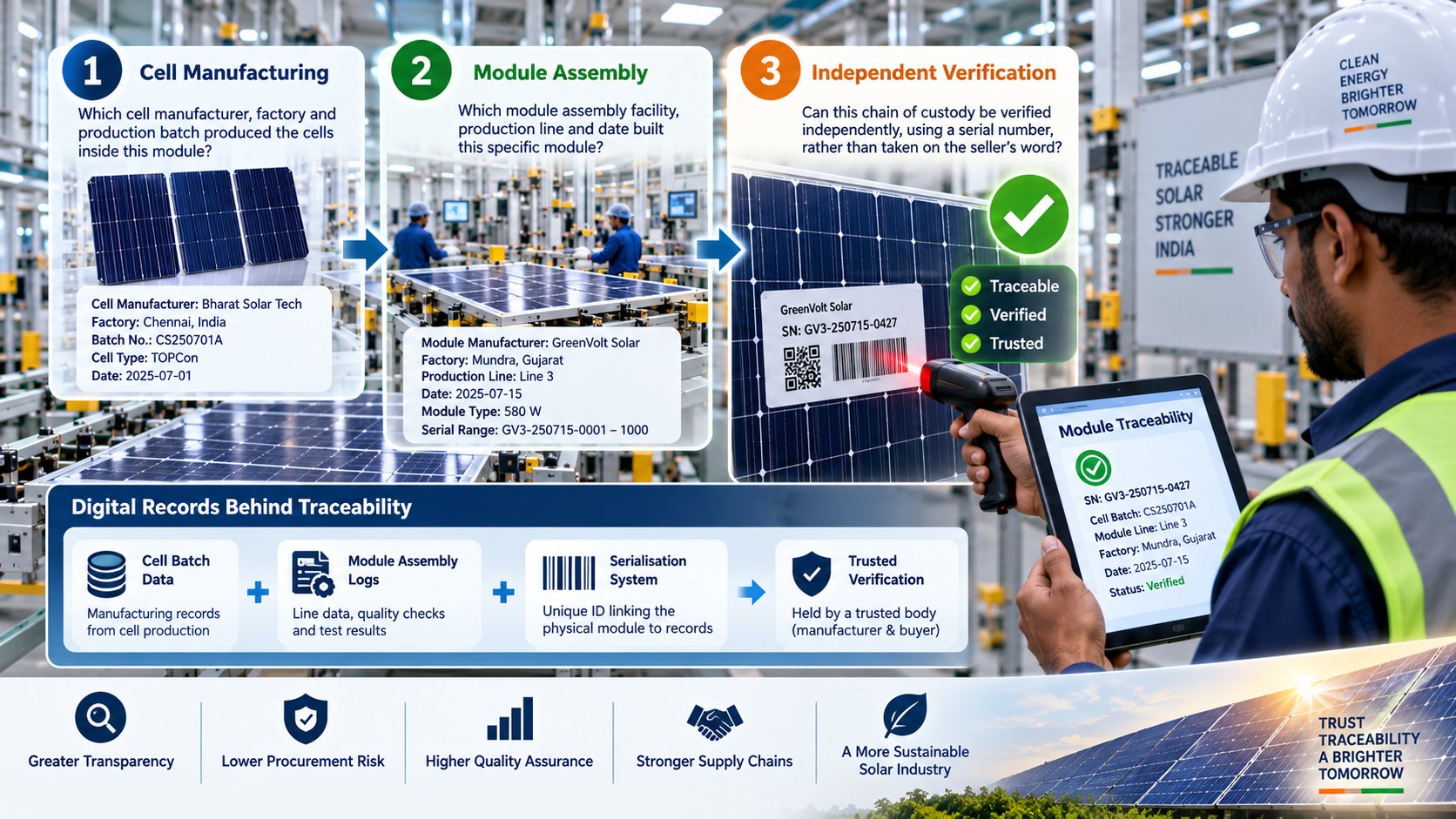
Traceability in solar manufacturing covers the ability to answer three linked questions for any given module:
- Which cell manufacturer, factory and production batch produced the cells inside this module?
- Which module assembly facility, production line and date built this specific module?
- Can this chain of custody be verified independently, using a serial number, rather than taken on the seller’s word?
This requires more than a label. It requires digital manufacturing records — cell batch data, module assembly logs, and a serialisation system that ties a physical unit back to those records — held by a body that both the manufacturer and the buyer trust.
Serialisation and Cell-to-Module Tracking
Every module produced for a scheme requiring DCR compliance is expected to carry a unique serial number. That number is not decorative. It is the index key that links the physical module in the field back to the manufacturing data submitted by the producer: which cell batch went into it, which line assembled it, and when.
This is what “cell-to-module tracking” means in practice — the record isn’t just “this module was made in India,” it is “these specific cells, from this specific cell manufacturer’s batch, were assembled into this specific module, on this date, at this facility.” That level of granularity is what makes DCR verification meaningful rather than a paperwork exercise, and it is the reason Websol’s existing guide on DCR vs non-DCR solar cells is worth reading alongside this one — that article explains the policy distinction; this one explains how it is actually verified.
How India’s DCR Verification Ecosystem Works
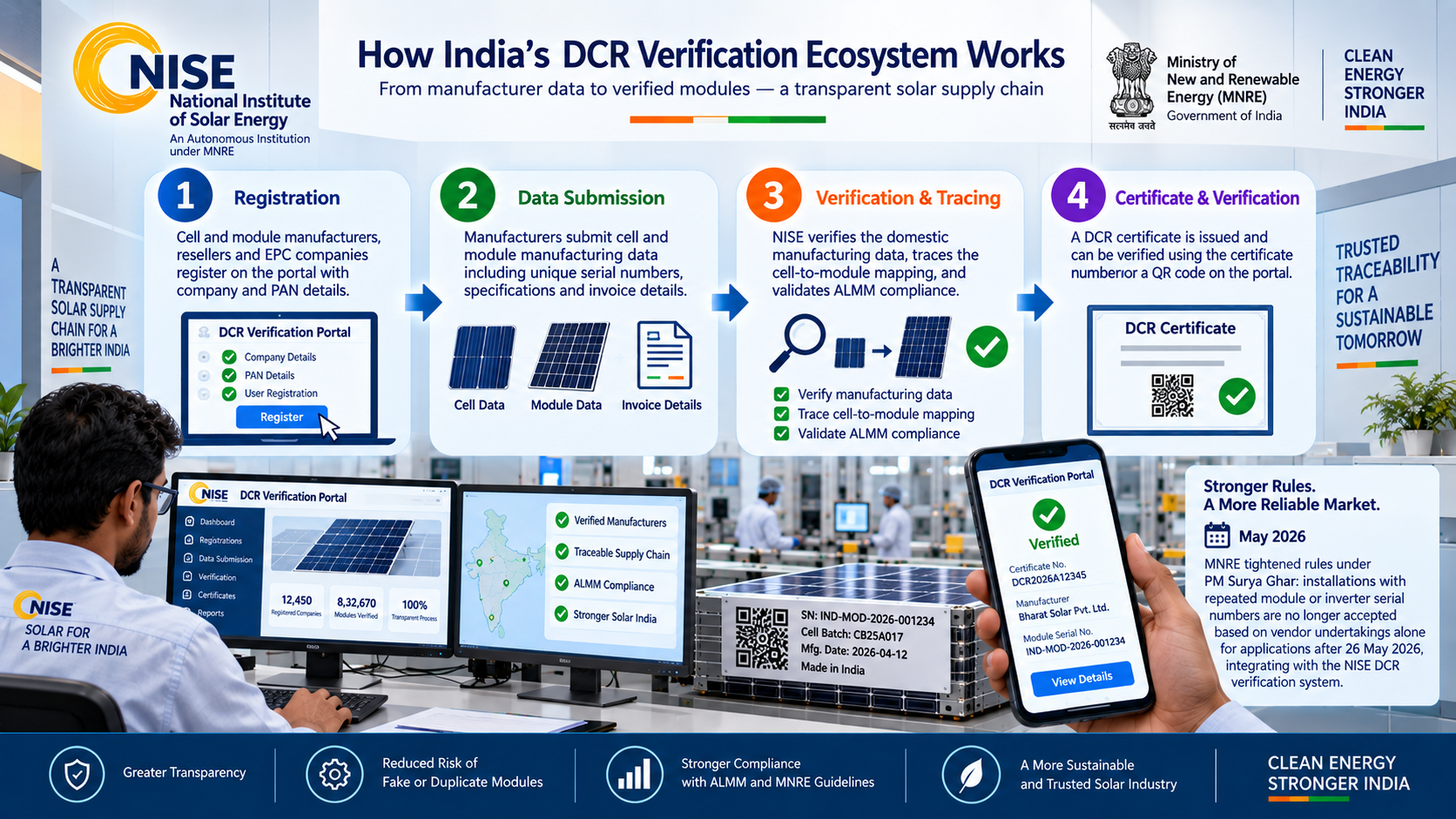
India’s traceability infrastructure for solar is centred on the National Institute of Solar Energy (NISE), an autonomous institution under the Ministry of New and Renewable Energy (MNRE), which operates the DCR Verification Portal. According to NISE’s own portal documentation, the system works through a four-step process: cell and module manufacturers, along with resellers and EPC companies, register on the portal with company and PAN details; manufacturers submit cell and module manufacturing data including unique serial numbers, specifications and invoice details; NISE then verifies the domestic manufacturing data, traces the cell-to-module mapping, and validates ALMM compliance.
For a buyer or auditor, this means a specific module’s DCR certificate — or its serial number — can be checked directly against this record, rather than relying on the manufacturer’s paperwork alone. The portal also allows verification of the authenticity of any DCR certificate using the certificate number or a QR code scan, per NISE’s published system description.
This infrastructure has become more consequential, not less, as scrutiny has increased. In May 2026, MNRE tightened rules under PM Surya Ghar specifically to address gaps in the previous system: the ministry announced that installations containing repeated solar module or inverter serial numbers would no longer be accepted based on vendor undertakings alone for applications submitted after 26 May 2026, integrating the residential rooftop scheme’s National Portal more tightly with the NISE DCR verification system. The change was a direct response to the fact that duplicate or reused serial numbers had been allowed through on manual vendor declarations — precisely the kind of gap that a genuine serialisation and verification system is meant to close.
Why This Matters Beyond Government Schemes
It would be a mistake to treat traceability as a compliance checkbox that only matters for PM Surya Ghar, CPSU Phase-II or PM-KUSUM projects. It has commercial value in several other situations:
Warranty claims. When a module underperforms or fails within its warranty period, the manufacturer needs to identify the specific production batch to determine whether the issue is isolated or systemic. Without serialisation tied to batch records, warranty investigations rely on visual inspection and manufacturer goodwill rather than data.
Product recalls. If a defect is traced to a specific cell batch or assembly period, a manufacturer with proper traceability can identify exactly which modules, at which project sites, need inspection — rather than issuing a blanket recall or, worse, being unable to identify the affected population at all.
Quality investigations. EPCs and asset owners increasingly want batch-level data when diagnosing field issues like degradation clusters, hot spots or early failures, particularly on large utility-scale portfolios where even a small defect rate translates into a meaningful number of affected modules.
Counterfeit and relabelled products. A serialisation system that ties back to verified manufacturing records makes it far harder to relabel imported or non-compliant cells as DCR product, because the serial number itself is checked against submitted manufacturing data rather than simply printed on a sticker.
Procurement verification. For distributors, EPCs and government tender evaluators, the ability to independently verify a module’s origin — rather than relying on a supplier’s self-declaration — reduces procurement risk on large contracts where DCR non-compliance can trigger penalties or subsidy rejection.
What Traceability Does Not Solve
It is worth being precise about the limits of the current system. NISE’s portal verifies that submitted manufacturing data is consistent and that serial numbers are not duplicated or fabricated — but the credibility of that data still depends on manufacturers submitting accurate records in the first place. Traceability infrastructure reduces the opportunity for undetected misrepresentation; it does not eliminate the need for manufacturers to have genuinely reliable internal quality and batch-tracking systems, of the kind described in Websol’s article on solar module quality certifications. Certification (IEC, BIS) verifies that a module design and sample meet a technical standard; traceability verifies that a specific unit corresponds to the manufacturing claims made about it. Buyers need both.
A Practical Verification Checklist for Buyers
|
Step |
What to check |
Why it matters |
|
1 |
Is the manufacturer registered on the NISE DCR Verification Portal? |
Confirms the manufacturer participates in the formal traceability system at all |
|
2 |
Does the module carry a unique, non-repeated serial number? |
Basic prerequisite for any traceability claim |
|
3 |
Can the DCR certificate be verified via the portal’s certificate/QR lookup? |
Independently confirms the certificate is genuine, not just printed |
|
4 |
Is the module ALMM-listed under the correct list (I or II) for the scheme in question? |
ALMM listing and DCR compliance are related but separate checks |
|
5 |
Does the manufacturer hold relevant module quality certifications (IEC 61215/61730, BIS)? |
Traceability confirms origin; certification confirms design and build quality — see Websol’s guide on what buyers must verify |
|
6 |
For subsidy-linked residential projects, is the installation compliant with the tightened serial-number rules introduced in May 2026? |
Directly affects PM Surya Ghar subsidy eligibility |
For readers evaluating suppliers more broadly rather than a single shipment, Websol’s complete guide to solar cell manufacturers in India and its guide on PM Surya Ghar panel qualification are useful companion reading, since traceability is one input into a much larger supplier-evaluation process.
The Direction of Travel
Traceability systems tend to move in one direction once introduced: toward more granularity, not less. The May 2026 tightening of PM Surya Ghar rules is a useful signal of where this is headed — regulators are moving away from manual, vendor-declared compliance and toward systems where an individual unit’s history is checked against a central digital record by default. For manufacturers, this means internal batch and serialisation discipline is no longer just a quality-control nicety; it is close to a market-access requirement. For buyers, it means procurement due diligence increasingly needs a traceability check as a distinct line item, separate from certification and pricing.
Key Takeaways
- Traceability is the infrastructure that lets a specific module’s origin be verified against manufacturing records — it is not the same as DCR policy itself.
- India’s system is coordinated through NISE’s DCR Verification Portal, which links serial numbers, cell batch data and module assembly records.
- MNRE tightened enforcement in May 2026, closing a loophole that had allowed vendor-declared serial numbers without independent verification.
- Traceability supports warranty claims, recalls, quality investigations and anti-counterfeiting, well beyond simple scheme compliance.
- Traceability and certification answer different questions and buyers need both.