

From the outside, a technology transition looks like a press release: a manufacturer announces it is converting a Mono PERC line to TOPCon, or adding HJT capacity. What that announcement doesn’t show is the 12-to-24-month operational reality behind it — a period in which the factory is neither reliably producing its old product nor its new one at full quality, while customers wait, workers retrain, and equipment that worked perfectly for one process has to be requalified, modified or replaced for another.
This matters more in solar than in most manufacturing sectors, because the industry’s technology cycle has genuinely accelerated. Mono PERC dominated Indian cell manufacturing for years; by 2026, roughly 70% of India’s installed module manufacturing capacity was based on TOPCon technology, with the remainder split between HJT and residual PERC lines. That shift didn’t happen overnight, and it didn’t happen without cost — for every line that switched, someone absorbed a transition period of reduced output, elevated scrap, and delayed customer deliveries.
Why This Isn’t “Just New Equipment”
A solar cell production line is not a set of independent machines bolted together. It is a tightly interdependent sequence — texturing, diffusion, passivation, metallisation, testing — where the output specification of one step is the input specification of the next. Changing the underlying cell technology changes the physics and chemistry at multiple steps simultaneously, not just one.
Moving from Mono PERC to TOPCon, for example, means adding a tunnel-oxide and doped-polysilicon layer to the rear of the cell — a step that doesn’t exist in a standard PERC process at all, requiring new deposition equipment (typically LPCVD or PECVD) and new furnace recipes for the additional thermal oxidation step. Moving toward HJT is a more fundamental change again, since it requires an entirely different deposition technology (PECVD amorphous-silicon layers) and low-temperature silver paste metallisation that cannot be co-fired the way PERC and TOPCon contacts are — a difference that shows up directly in cost, since HJT cells use silver loading 25-35% higher than TOPCon at a comparable busbar count, according to industry cost analysis.
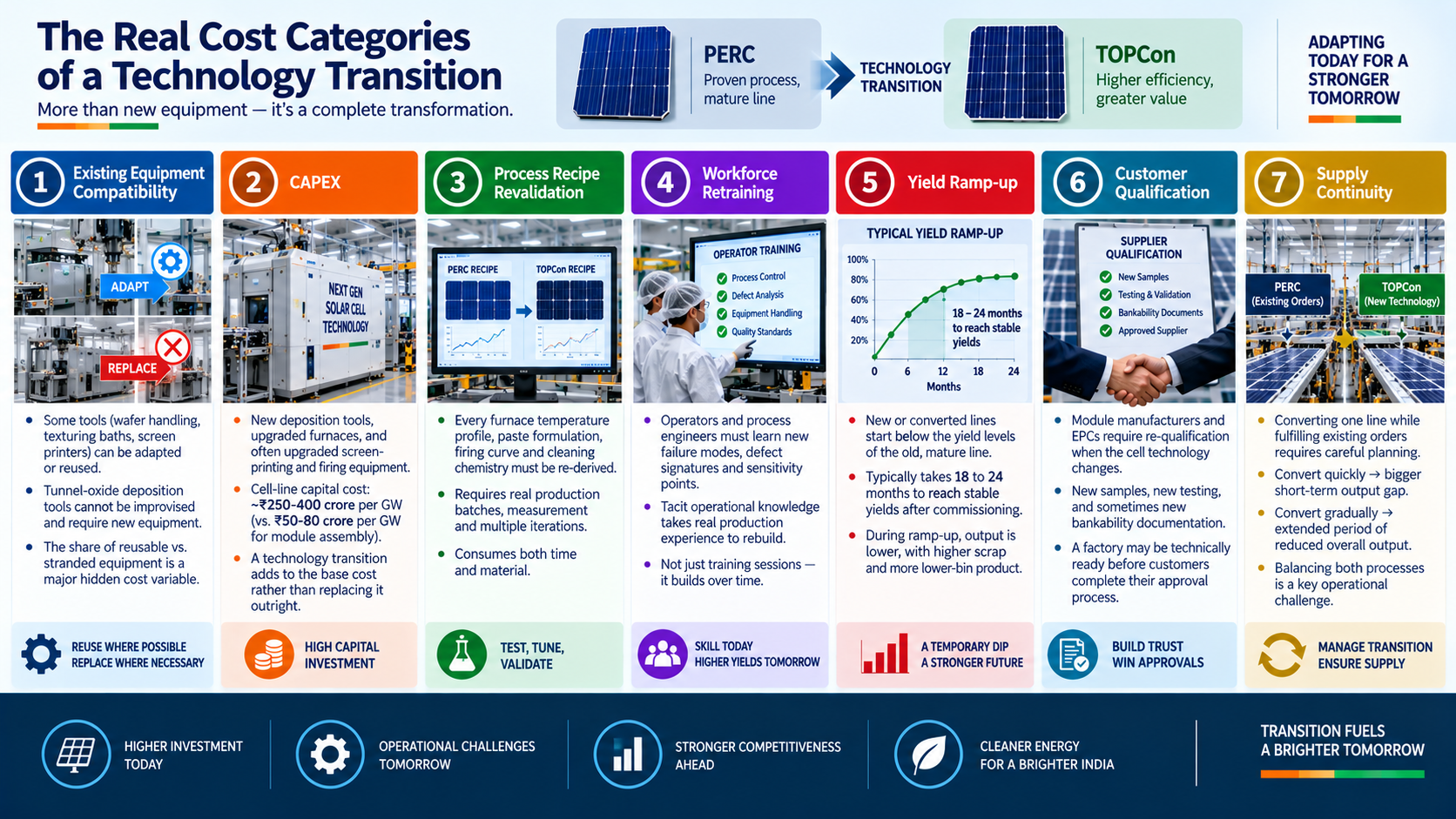
The Real Cost Categories of a Technology Transition
Existing equipment compatibility. Some tools in a PERC line — wafer handling, texturing baths, screen printers — can often be adapted or reused for TOPCon with modification. Others, particularly the tunnel-oxide deposition step, cannot be improvised from existing PERC tooling at all and require new capital equipment. The share of a line’s capital stock that is genuinely reusable versus stranded is one of the biggest hidden variables in any transition’s real cost.
CAPEX. New deposition tools, upgraded furnaces, and often upgraded screen-printing and firing equipment to handle different paste chemistries and firing profiles all represent capital spend beyond the “headline” cost of adding a technology. Cell manufacturing capital intensity is already high relative to module assembly — industry estimates put cell-line capital cost at roughly ₹250-400 crore per GW, versus ₹50-80 crore per GW for module assembly — and a technology transition adds to that base cost rather than replacing it outright when equipment can’t be repurposed.
Process recipe revalidation. Every furnace temperature profile, paste formulation, firing curve and cleaning-bath chemistry that was tuned for the old technology has to be re-derived for the new one. This isn’t a documentation exercise — it typically requires running real production batches, measuring outcomes, and iterating, which consumes both time and material.
Workforce retraining. Operators and process engineers who developed intuition for troubleshooting a PERC line’s specific failure modes need to build equivalent intuition for a new technology’s different failure modes — different defect signatures, different EL image patterns, different sensitivity points. This kind of tacit operational knowledge takes real production experience to rebuild, not just training sessions.
Yield ramp-up. New or converted lines almost universally start below the yield levels the old, mature line had achieved. Industry reporting on new Indian TOPCon capacity has noted that cell production lines typically take 18 to 24 months to reach stable yields after commissioning. During that ramp period, a factory is producing at below-design output, with a higher proportion of scrap and lower-bin product than it will eventually achieve.
Customer qualification. Module manufacturers and EPCs that buy cells from a given factory typically require re-qualification when the underlying cell technology changes — new samples, new testing, sometimes new bankability documentation for lenders and insurers. A factory can be technically capable of producing a new cell technology well before its major customers have finished requalifying it as an approved supplier for that product.
Supply continuity. A factory converting one line to a new technology while continuing to fulfil existing orders for the old technology has to manage the trade-off between converting quickly (accepting a bigger short-term output gap) and converting gradually (extending the period of reduced overall output while both processes run in parallel at reduced efficiency).
Why the Learning Curve Is the Hardest Part to Shortcut
Equipment can be purchased. Recipes can eventually be tuned through iteration. What is genuinely difficult to accelerate is the accumulated operational experience of running a specific line at scale — the pattern recognition that lets an experienced process engineer look at an EL image or an I-V curve and immediately know which upstream step is drifting. This is precisely the kind of expertise that underpins the batch-consistency and quality-control practices described in Websol’s article on EL testing, binning, PID, LID and batch consistency — and it is exactly this kind of tacit knowledge that has to be substantially rebuilt, not just transferred on paper, whenever the underlying process changes materially.
Automation can shorten some parts of this curve by reducing the variability introduced by manual handling and judgment calls, which is part of why automation investment — covered in Websol’s piece on how automation is reducing solar production costs — has become more, not less, important as technology cycles compress. But automation reduces variance around a process; it doesn’t replace the need to actually establish what the correct process parameters are for a new technology in the first place.
TOPCon, HJT and the Silver Cost Dimension of Transition
Technology transitions in solar today are rarely just about cell architecture — they usually carry a materials-cost dimension as well. TOPCon’s rise has been paired with steady reduction in silver consumption per cell through finer, more numerous busbars and improved paste formulations, a trend covered in Websol’s explainer on why silver matters in solar cell manufacturing. A factory transitioning toward HJT, by contrast, currently faces the opposite direction of travel on silver intensity, since HJT’s low-temperature paste requirements mean higher silver loading than TOPCon at a comparable busbar count. Any factory evaluating a transition has to weigh the technology’s efficiency and reliability advantages against this kind of structural materials-cost difference, not just the capital cost of new tooling.
For readers wanting the technology comparison itself rather than the transition mechanics, Websol’s existing guide on TOPCon vs Mono PERC vs HJT and its explainer on understanding solar cell technologies cover the electrical and commercial trade-offs between the technologies themselves.
A Practical Framework: What to Ask About a “Converted” Line
For anyone evaluating a cell supplier that has recently transitioned or is transitioning technology, the useful questions are less about the announced capacity and more about the operational reality behind it:
|
Question |
Why it matters |
|
How long has this specific line been running the new technology in volume production? |
Directly informs where the line likely sits on its yield ramp-up curve |
|
What share of the previous line’s equipment was reused vs newly purchased? |
Indicates how much of the process had to be rebuilt from scratch |
|
Has the factory been re-qualified by its major existing customers for the new cell type? |
A technically capable line isn’t the same as a commercially validated supplier |
|
What is the batch-to-batch consistency of recent shipments? |
The clearest practical signal of how far along the yield ramp the line actually is |
Key Takeaways
- A cell technology transition changes physics and chemistry at multiple linked process steps simultaneously, not just one piece of equipment.
- New cell technologies typically require 18-24 months after commissioning to reach stable yields.
- Costs span new capital equipment, process recipe revalidation, workforce retraining, yield-ramp scrap, and customer re-qualification.
- Materials cost structure (particularly silver) can shift meaningfully with a technology change, independent of the capital cost of transition.
- The hardest part of a transition to shortcut is the accumulated operational experience needed to run the new process reliably at scale.